Wednesday, September 23, 2026

An Important Effort by Trump Administration to Expand Recycling

 4/15/26 AP:

The Environmental Protection Agency is reconsidering whether facilities that recycle plastic chemically should be held to the same strict air pollution standards as incinerators.

The possible change is alarming environmental advocates who say it would lead to more dangerous pollution spewing into communities, with fewer or no checks at the federal level. The plastics industry disputes that, saying it would clear up confusion while still controlling emissions.

The world is pumping millions of tons of plastic pollution into the environment every year. While dozens of countries and many environmental groups have urged caps on production, industry and several big oil-producing countries have resisted, arguing instead for improvements in reuse and recycling.

Chemical recycling uses heat or chemicals to break down plastics. The main method, a process known as pyrolysis, has long been regulated as incineration by the Clean Air Act. The EPA limits emissions from incinerators of nine air pollutants, including toxic particulates, heavy metals and dioxins.

The agency says a potential new rule could instead recognize pyrolysis as manufacturing.

The American Chemistry Council, an industry group, has long argued for such a change.

How dare you solve a landfill and ocean pollution problem! 

MSM Does Journalism

 9/15/26 Newsweek:

Images claiming to show President Donald Trump kissing his executive assistant, Natalie Harp, on a golf course have circulated widely on social media, prompting questions about whether they are genuine....

No established news organization, official White House photographer or photo agency has been identified as the source of either image. Searches of White House material and photographs published by AP, Reuters and Getty Images did not locate a corresponding image from the purported encounter.


The two circulating pictures appear to be versions of the same scene rather than independent photographs corroborating one another. One is clearer, while the other is blurred and contains fewer details that can be examined.


The higher-resolution version contains several visual irregularities associated with AI-generated imagery. Harp’s visible hand appears to have six fingers, while parts of the golf equipment and background lack consistent shapes and detail. The lower-resolution image is too degraded for some of those anomalies to be seen clearly, but blurring an image does not establish that the underlying scene is authentic.


Newsweek also submitted both versions to Grok, the AI assistant developed by xAI. Its assessment was consistent with the anomalies outlined above. Grok said no single irregularity proved fabrication but concluded that the combined evidence was characteristic of an AI-generated image that had subsequently been blurred or compressed.


Newsweek further asked ChatGPT to assess the files. It said the irregularities described above were consistent with AI generation or substantial digital manipulation and found no useful camera, date, location or editing metadata embedded in either image. ChatGPT cautioned that metadata is often removed during online sharing and therefore cannot settle the question alone, but assessed fabrication as the more likely explanation.


OpenAI’s verification tool found no SynthID watermark or trusted C2PA record linking the image to OpenAI products, but cautioned that this did not rule out its creation with another AI system....


The images do not authentically show Trump kissing Harp on a golf course. No verified source for the purported photographs has been identified, and the clearer version contains visual anomalies associated with AI generation, including what appears to be a sixth finger on Harp’s hand. The two pictures are versions of the same unverified scene, not separate images confirming that the encounter occurred.

The Headline Sounds Like Big Mother is Going to Knock on the Door

 The actual article seems not bad at all, except for the cost to preventwhat is actually a rare but tragic situation. 9/21/26 Daily Caller:

Massachusetts Responds To Lindsay Clancy Failure By Expanding Home Surveillance Of New Moms..

Democratic Massachusetts Gov. Maura Healey recently proposed expanding home visits from nurses for new parents and postpartum mental health screenings across the state.

Healey has proposed a $2 million investment to provide universal access to the Department of Public Health’s (DPH) Welcome Family program across the state and also $250,000 to broaden the Department of Mental Health’s Massachusetts Child Psychiatry Access Program for Moms, according to a Sept. 15 news release. The move comes as the Lindsay Clancy trial in Massachusetts has fueled an intense public debate about postpartum mental health conditions. (RELATED: Patrick Clancy Says Lindsay Never Asked Forgiveness For Killing Their Kids)

Welcome Family is a voluntary and free home visiting program “that supports parents and caregivers in the weeks after a baby is born,” per the announcement. The program presently serves 3,000 births annually, according to Healey’s office.

Critters in the Pool

No, not bears.

The rodent was doing a decent dog paddle. I removed him with a skimmer net. I put him next to the fence where he was shivering up a storm. My wife's last experience saving a rodent from bigger threats went so poorly that she did not immediately look for a little blanket for it. A few hours later, he was gone.


Yesterday's 9th Circus En Banc Decision

 YUKUTAKE V. LOPEZ (9th Cir. 2026) (en banc) involves provisions of Hawaii's law:

1. That requires those who meet their standards for firearms purchase to then buy the gun within 30 days or start all over again, and,

2. Bring the gun to a police station within five days after acquisition for inspection.

The en banc decision upheld both provisions, claiming that footnote 9 of Bruen makes any shall-issue law presumptively constitutional:

As detailed infra, Bruen instructs courts to engage in a two-step inquiry: First, does the Second Amendment’s plain text cover the plaintiff’s conduct?  And second, if so, is the legislation at issue consistent with the Nation’s historical tradition of firearm regulation?  Id. at 24.  Yet in a footnote, the Bruen Court included an apparent carve-out to this test: objective, non-abusive “shall-issue” licensing regimes are presumptively constitutional.  Id. at 38 n.9.  

As Judge Nelson's dissent observes:

But the majority incorrectly holds that footnote 9 of New York State Rifle & Pistol Ass’n v. Bruen, 597 U.S. 1 (2022), creates a “carve-out” or “safe harbor” from Second Amendment scrutiny, and is thus analytically distinct from Bruen’s framework.  Maj. Op. 13, 18.  Footnote 9 does not say that all objective regulations placed within a “shall issue” licensing regime are “presumptively constitutional.” Id. at 13.  It only addresses “public carry” regulations not at issue here.  Bruen, 597 U.S. at 38 n.9.  And it does not shift to the citizen the burden to prove that a law governing protected conduct has been “put toward abusive ends.”  Maj. Op. 17 (cleaned up).  That interpretation violates Bruen’s clear command that it is the government’s burden to show that restrictions on the right to keep and bear arms are “consistent with the Nation’s historical tradition.”  597 U.S. at 24.   

Instead, footnote 9 described non-abusive regulations to ensure that only “law-abiding, responsible citizens” were carrying handguns outside the home, preserved challenges when a permitting system denies citizens their right to carry, and concerned only longstanding licensing regimes.  Id. at 38 n.9 (citation omitted). 

Hawaii’s challenged provisions are something else.  Hawaii requires purchasers of handguns to obtain a handgun-acquisition permit that is void unless the permittee completes the purchase within 30 days, and it requires persons acquiring certain firearms to bring them to a police station for physical inspection within five days of acquisition.  Haw. Rev. Stat. §§ 134-2(e), 134-3(c).  Neither regulation has anything to do with determining whether applicants are “‘law-abiding, responsible citizens’” eligible for licenses to “exercis[e] their Second Amendment right to public carry.”  Bruen, 597 U.S. at 38 n.9 (quoting District of Columbia v. Heller, 554 U.S. 570, 635 (2008)).  Indeed, the challenged laws operate after the applicant has completed a background check, firearms training course, and myriad other requirements—i.e., after he has proven himself a “lawabiding, responsible citizen”—and has been issued a permit to purchase (not carry) a handgun.  And neither regulation was “longstanding” in 2022 when Bruen issued. 

Nelson goes on to point out these laws did not develop based on public concerns about safety but as part of a not very subtle attempt to ignore Bruen

This case is all the worse since the challenged laws appear to be part of Hawaii’s consistent and not-so-subtle attempts to end run around the Second Amendment, which suggests that these laws are abusive under footnote 9.  See, e.g., Young v. Hawaii, 45 F.4th 1087, 1090–94 (9th Cir. 2022) (en banc) (O’Scannlain, J., dissenting); Teter v. Lopez, 76 F.4th 938, 942–43, 947–49 (9th Cir. 2023), reh’g en banc granted, opinion vacated, 93 F.4th 1150 (9th Cir. 2024), vacated as moot on reh’g en banc, 125 F.4th 1301 (9th Cir. 2025); State v. Wilson, 543 P.3d 440, 442 (Haw. 2024), abrogated by Wolford v. Lopez, 146 S. Ct. 2032, 2050 (2026).  Hawaii has only grown more intransigent in its “blatant defiance” of the Supreme Court’s clear commands on the Second Amendment.  Wilson v. Hawaii, 145 S. Ct. 18, 21 (2024) (Statement of Thomas, J., respecting the denial of certiorari) (citation omitted); cf. Granillo v. State, 593 P.3d 1, 28 (Haw. 2026) (accusing the U.S. Supreme Court of “[m]aking the country more dangerous with a Second Amendment unmoored from text or history and unrecognizable to the framers who wrote it”); id. (Bruen was “deadly jurisprudence,” and Wolford “show[ed] disdain for Hawai‘i’s constitutional traditions.”).  But Hawaii’s “[m]erely local attitudes can neither shrink nor inflate the meaning of fundamental Bill of Rights guarantees that apply to the States through the Fourteenth Amendment.”  Wolford, 146 S. Ct. at 2050. 

A correct application of Bruen to Hawaii’s regulations makes this case straightforward.  First, the Second Amendment’s plain text covers the acquisition of arms.  A person ordinarily cannot “keep” an arm without first acquiring it, and the law has long recognized that authorization of an act includes authorization of necessary predicate acts.  Luis v. United States, 578 U.S. 5, 26 (2016) (Thomas, J., concurring in the judgment).  Hawaii’s statewide restrictions govern the process by which ordinary citizens take possession of handguns; possession is the core conduct protected by the “right of the people to keep . . . Arms.”  U.S. Const. amend. II (emphasis added).  Second, Hawaii has not identified “a well-established and representative historical analogue” for either its short permit-use period or its acquisition-linked inspection mandate.  Bruen, 597 U.S. at 30.  Because Hawaii has not carried the burden Bruen places on the government, we should have affirmed the district court’s judgment.  I respectfully dissent.

Oh and Judge Van Dyke's dissent is also powerful:

But in spite of the Court’s obvious efforts to instruct lower courts to enforce the Second Amendment, the Ninth Circuit has done precisely the opposite.  That’s not a rhetorical statement: in this circuit, the Second Amendment safeguards less liberty now than it did in the wake of Heller.2 For Exhibit A on how things have changed in the wrong direction, look no further than the majority’s opening paragraph.  The majority recalls that the district court “blocked the implementation of [Hawaii’s] firearm licensing regime on Second Amendment grounds” the year before Bruen was decided.  Maj. Op. at 10.  The legal basis for reversing that injunction, according to the majority, is the “guidance” that Bruen provided on “how courts should analyze ‘shall-issue’ regimes like Hawaii’s.”  Id.  I agree that Bruen changed the law.  But if our court’s takeaway from Bruen is that Bruen changed the law to make it harder to mount a successful Second Amendment challenge, then somebody has seriously lost the plot.  

Tuesday, September 22, 2026

Sunday, September 20, 2026

Another Recent Novel

David Brin The Uplift War 3 is apparently volume 3 in a series set in a universe where species with salient potential are uplifted by a patron alien species. Humans are a weird exception having civilized enough to develop space travel without being uplifted, although some of the older and more arrogant species think we could have evolved sapience but whoever are true patron species did not take credit for it. Anyway, humans have interfered with chimpanzee and dolphin genetics to create creatures that can talk earn doctorate and generally operate as only socially inferior parts of the community. The plot involves an angry avian species (no, not Angry Birds) intent on taking away patron status from human patron as part of a multigalactic Cold War just beginning to grow hot. I will not spoil it by telling you more.

Brin is a scientist with a doctorate and the quality of the thought and writing is astonishing.  My only complaint is that while I think of myself as being a very literate person, I often needed to look up words, especially adjectives. I found myself often reminded of William F. Buckley using five dollar words when a fifty cent word would do the job fine.

Churchill's Second World War and T.E. Lawrence's Five Pillars of Wisdom also both stretched my vocabulary in places but not as severely as this. There comes a point where I decide that as entertaining of a yarn as Brin has spun, this may be more work than I want to expend for fun reading. Simak's books very occasionally make me look up a word but then again, he was writing for a better educated readership than is common today.

Clifford Simak The Visitors

Published in 1980. It has strong very intentional parallels to what happened when a technologically more sophisticated civilization (Europeans) arrived in North America at least how an exchange economy largely destroyed the Indian economic order as superior technology such as iron and firearms supplanted native cooking utensils and the bow. This in surprisingly short order made the Indians dependent on the Europeans. The bow had largely fallen out of use by Northeast woodland Indians by 1690 -- and gave Europeans a powerful tool of control over them.

Here, the visitors are incomprehensible to 20th century Americans. They can communicate in a very limited way as they consume natural resources while exchanging them for things that we clearly want, destroying our industrial capacity along the way. Not with any malevolent intent but unable to see how destructive this would become. (At least one colonial governor in the 18th century did recognize how firearms made the Indians dependent and bragged to London about his success.)

Imaginative and entertaining as all Simak novels are.

Italy Looking Out for Italians

9/20/26 Reuters:
MILAN, Sept 20 (Reuters) - Italy is preparing to ban face coverings in schools and to cap the number of foreign students per class, Prime Minister Giorgia ​Meloni said on Sunday as she played up her right-wing ‌credentials at a youth event organised by her party...

"If there is ‌only ⁠one child in a class who doesn't understand Italian, that child will likely be able to learn the language and integrate quickly with the help of classmates and teachers. However, if the number of children who don't understand ​the language becomes ​large - or even ⁠the majority - that is no longer integration; it is neglect," she added.

Saturday, September 19, 2026

When Public Safety Agencies Reduced Physical Requirements for Employees Doing Jobs Requiring Strength...

Would you have expected it to go this far?

I am sure there are valuable jobs this short and clearly weak woman could have done for EMS, but this was not one of them.

Another Citation

Memorandum Opinion by U.S. Attorney-General:

Application of 18 U.S.C. § 922(b)(1) and (c)(1) to Young Adults Section 922(b)(1) and (c)(1) of title 18, U.S. Code, is unconstitutional as applied to young adults between eighteen and twenty who seek to purchase handguns. The provision prevents young adults, who are members of “the people” to whom the Second Amendment applies, from owning “arms” in common use for self-defense. This places the burden on the government to show that the restrictions are consistent with the  Nation’s tradition of firearm regulation, which it cannot do. 

They cite me at pp. 43-44:

Pistols, though less common than other firearms, existed at the Founding and were a familiar article of early American commerce. See Clayton E. Cramer & Joseph Edward Olson, Pistols, Crime, and Public: Safety in Early America, 44 Willamette L. Rev. 699, 706–11 (2008) (outlining the prevalence of pistols at the time of the Founding).  

How important are such opinions? Apparently, pretty important. To quote from an Obama-era memo "MEMORANDUM FOR ATTORNEYS OF THE OFFICE Re: Best Practices for OLC Legal Advice and Written Opinions "

As noted above, OLC's central function is to provide, pursuant to the Attorney General's delegation, controlling legal advice to Executive Branch officials in furtherance of the President's constitutional duties to preserve, protect, and defend the Constitution, and to "take Care that the Laws be faithfully executed." 

More Progress on Gun Rights

 Elite Precision Customs v. BATF (5th Cir. 2026):

Plaintiffs unsuccessfully sought a permanent injunction against several provisions of 18 U.S.C. § 922 that collectively prohibit the buying and selling of handguns across state lines.  The only issue is whether those provisions are constitutional under the Second Amendment.  They are not:  Under Bruen, they implicate the Second Amendment’s plain text, making them presumptively unconstitutional, and the government has failed to meet its burden to justify the provisions as consistent with the nation’s tradition of firearms regulation.  We reverse and render judgment for plaintiffs. 

The GCA68 provision that prohibited sale of handguns to persons not a resident of state of sale had a certain logic: in 1968, there was no national database (what's a database?) that allowed for a nationwide check to see if you were a prohibited person in some state. Some states had provisions for this, or at least pretended that they did. Even quite recently, some states considered mental hospital records as so private that they could not check for involuntary commitments. 

We now have the NICS database that allows dealers to check if a buyer is disqualified from purchase. This may well expand sales at gun shows of handguns.

Parody of Woke? Or Evidence of How Insane 2025 Still Was?


If You Told Me This Was Parody of Woke

Why Did I Not Notice This?

9/4/26 Bureau of Labor Statistics reports 4.1% unemployment rate in August. The only lower rate in recent years was when Trump was inaugurated.

Friday, September 18, 2026

Great Video of Berkeley Law School Dean Admitting That He Will Perjure Himself About DEI

He is lecturing to a class and explains how they discriminate in hiring because unlike student admissions where N is large enough that statistical evidence of racial discrimination is impossible to prevent.  

This is clearly not too smart of a guy, making a direct admission that he tells other faculty to not admit that they are making racially discriminatory hiring decisions but do it silently. Then admits that he will deny what he just said if deposed. When deposed, you are under oath. He is loudly telling his students that he is going to perjury himself

Also, making such a statement in a restaurant with several like-minded bigots would be pretty safe but doing so in a classroom where students could be taping you is evidence of being too stupid to have a job.

A Surprising Story From CNN

9/17/26 CNN:

The bond market gave the Federal Reserve an ultimatum: Raise rates, or we will.

 So the Fed did the only thing it could do. Backed into a corner by rising Treasury yields and inflation, the central bank boosted its target interest rate Wednesday for the first time since 2023.

Americans have suffered from a persistent inflation problem for five years, and an interest rate hike is a powerful weapon that could help squash it. But it’s a blunt tool that comes with a nasty side effect: It can unintentionally turn the job market into collateral damage.

Still, for Fed Chairman Kevin Warsh & Co., this isn’t any ordinary inflation problem. It’s mainly a result of high energy prices caused by the war with Iran, and as my colleague Matt Egan noted in July: Warsh can’t reopen the Strait of Hormuz.

So the bond market got its wish Wednesday, and the reasonably strong job market and robust consumer spending probably gave the Fed enough room for error.

But the Fed is playing with fire. Raising interest rates risks slowing down the American economy without anything to show for it.
‘Weak case’

Before the Fed decision, some prominent economists were already on its case.

Goldman Sachs economists suggested in a note to clients this week that the case for a rate hike was “weak,” based on the state of the US economy. They argued the economy wasn’t overheating, demand wasn’t excessive, and the supply shocks fueling inflation – namely high oil and fuel prices – would correct themselves once the war ended.

It’s not that the Iran war and Ukraine’s attacks on Russian diesel refineries are part of the problem; they are the problem – all of it, Goldman’s economists said....

The Fed typically “looks through” supply shocks because they’re temporary and rate hikes are ineffective at combatting them. And once they fix themselves, the Fed may find that interest rates now are too high, artificially raising borrowing costs for businesses and consumers without actually tackling inflation.

“The Fed cannot control energy prices,” said Michael Pearce, chief US economist at Oxford Economics. “The economy is solid and can withstand a few rate hikes, but the risk is higher interest rates begin to weaken the labor market.”

Other discussions of the hike are also interesting. 9/17/26 CBS News:

Warsh, who was named by President Trump to succeed longtime Fed Chair Jerome Powell earlier this year, has previously vowed to tackle inflation. But economists had been unsure of his commitment to that goal, given that he had also echoed some of Mr. Trump's views that the economy could benefit from lower interest rates.

What changed? Between the time Warsh was nominated in January and this week's Fed meeting, inflation has sharply accelerated, driven largely by the Iran war's impact on global oil prices.

In January, consumer prices were rising at an annual rate of 2.4%, within touching distance of the Fed's 2% target. But soaring crude prices have reversed that progress, sending the Consumer Price Index to a three-year high of 4.2% in May. While inflation has eased slightly since then, dipping to 3.4% in August, it's still far higher than Fed officials like.

"The plain fact is that inflation is too high, and has been for too long," Warsh said in a press conference after the Fed announced the rate hike on Wednesday, stressing that the Fed wants to take a "timelier" approach to curb price increases.

Those comments were interpreted as pointing to "higher rates for longer," Jaison Davis, economic research analyst at GlobalData, said in a report. "The bar for easing [rates] is now much higher, and it rests on clear evidence that inflation is heading back to target."
The Iran war is complicating life for the Fed

Warsh pointed to the impact of the war in Iran as one reason Fed officials were unanimous on the need to hike interest rates. The conflict, which has no end in sight, has severely reduced the flow of oil out of the Persian Gulf, while an escalation in fighting between Saudi Arabia and the Iran-backed Houthis in Yemen threatens another vital waterway.

Crude oil prices have jumped above $100 a barrel in recent weeks. The price increase has pushed fuel costs higher for Americans, who paid a record-high $6.40 per gallon for diesel on Thursday, a 73% jump from a year ago. Gasoline reached $4.44 a gallon, 38% higher than a year earlier, according to AAA data.
  9/17/26 Barron's:

The Federal Reserve has spent more than five years promising the American public that policymakers will bring inflation sustainably back to the central bank’s 2% annual target. On Sept. 16 the Fed raised interest rates in pursuit of that goal.

John Cochrane, a prominent economist and senior fellow at the Hoover Institution at Stanford University, thinks that higher rates are a short-term solution, at best. His research suggests that inflation will resume climbing unless fiscal policy also changes and the U.S. brings its borrowing and spending under control. Without more restrictive fiscal policy, he says, the Fed can only rearrange inflation in the face of a mountain of federal debt that recently surpassed $40 trillion. That’s because higher rates push up the government’s interest costs, leading to higher inflation in the long run.

Cochrane, previously a professor of finance at the University of Chicago Booth School of Business, has laid out these and other ideas in his popular blog, The Grumpy Economist He spoke with Barron’s on Sept. 11 about his economic research, the U.S. Treasury’s buyback of longer-dated debt, and the changes that Fed Chairman Kevin Warsh is implementing. An edited version of the conversation follows.

All of this makes sense. The Fed is legally obligated to keep inflation and unemployment balanced. This is at best a "threading the eye of the needle" problem at best; the insane deficits make this nearly impossible. The big gorilla in the room on interest rates is federal borrowing. If the U.S. government cannot control its borrowing, it will push out other borrowers, raising interest rates. Somehow, Congress will need to address this problem. At some point, pursuing Medicare/Medicaid/COVID fraud will make a difference but not quickly. 

Thursday, September 17, 2026

A Little Reminder That Insanity Often Only Delays Trial

 Paterson, N.J. (1973)

03/18/1973: Police charged a man, 33, with beating to death his wife and their three small children with a hammer. He was later transferred to a state mental hospital for evaluation. Psychiatrists determined he was “insane at the time and unable to stand trial.” In 1975, he was “declared to be sane enough to stand trial.” He had attempted suicide by a pill overdose. He was later “declared sane enough to stand trial.”

Category: family

Suicide: no

Cause: mental illness

Weapon: hammer[1]

More Bad Economic News

9/16/26 St. Louis Federal Reserve Bank reports inflation-adjusted median household income as of March again at record level. Now median and average are not same thing even though careless and ignorant people (usually politicians and journalists) often misuse them that way. Still unless there are an enormously large number of households will negligible incomes, this is still good news.

Why the Midterms May Not Be a Blue Wave

 9/15/26 Reuters:

WASHINGTON, Sept 15 (Reuters) - The U.S. ​poverty rate edged down to the lowest on record ‌in 2025, while median household income hit a record high, the Census Bureau said on Tuesday. There were 34.5 million people in poverty ​in 2025, the agency said.
The decline marked the second ​consecutive annual drop in the poverty rate and brought ⁠it to its lowest level since the bureau began tracking ​the measure. It came as policymakers debate the impact of ​federal spending cuts on safety-net programs.

9/15/26 Washington Post explains why this is not a basis for joy.


Why Deinstitutionalization of the Mentally Ill Matters

 Mill Valley, Cal. (1973)

Before 03/17/1973: “Police hunted today for a man in his early 20s seen leaving a burning home after a businessman, his wife and son were shot to death outside the hillside dwelling.” A neighbor saw the man leaving with a shotgun who rejected the neighbor’s poorly thought offer to help. “Go away,” was the response. Police found at least 22 shotgun shells.

At a subsequent trial of a man, 22, his defense attorney asserted that the murderer was paranoid schizophrenic and committed the murders because his friend, one of those murdered, “possessed supernatural powers which were bent of destroying [the murderer.” Also, “the Mafia was involved in his life and that Dan Shallock was involved and could not be killed, even by an H-Bomb.” “At one point he believed Dan Shallock was the devil, and to this day [the murderer] fear in his heart that Dan may come back.” The murderer had spent a month at Marin Community Mental Health Center, and in the days immediately prior to the slayings, his mother had been trying to persuade the youth to commit himself.”

It appears that the jury did not accept “not guilty by reason of insanity”; they convicted him of murder.

Category: family non-resident

Suicide: no

Cause: mental illness

Weapon: shotgun[1]


How Quintessentially 1970s Hippie Can You Get?

 Santa Cruz, Cal. (1973)

02/06/1973: Same killer and reasons as 01/25/1973: in this case, the victims were four “long-haired youths” who had built “a 10-by-12 foot, pyramid-shaped shelter constructed of pine saplings, branches, cardboard and plastic sheeting.”

Category: public

Suicide: no

Cause: mental illness

Weapon: firearm[1]

Wednesday, September 16, 2026

Remember When We Were Warned That Global Warming Would Increase Hurricanes?

 9/15/26 Ars Technica:

Last week, the Atlantic hurricane season blew through its traditional peak—which comes around September 10—with nary a tropical wave in sight, let alone a storm or hurricane.

This is remarkable. Usually this is the time of year when sea surface temperatures reach their warmest in the tropics, and with a favorable atmosphere it should be smooth skating for tropical systems. But this year, the main region where most tropical systems develop is choked with Saharan dust and wind shear.

No one is complaining. Landfalling hurricanes are incredibly destructive for coastal areas and have the potential for considerable inland rainfall. Even storms at sea, in the Gulf of Mexico, can send energy prices skyrocketing—the last thing needed this year.
This has never happened

Nevertheless, the quietude is historic.

Beginning in 1944, the United States began monitoring the Atlantic basin, which includes the Gulf, Caribbean Sea, and northern Atlantic Ocean, with aircraft to detect hurricanes. Dating back to 1944, a hurricane had formed every year by September 11. The latest “first” Atlantic hurricanes came in 2002, with Gustav, and in 2013, with Humberto on this date.

Atlantic hurricane records officially go back to 1851, although older records are less reliable because observations of storms developing at sea were reliant on reports from shipping vessels. So some storms were missed. If we extend the hurricane record all the way back to 1851, every year still records at least one Atlantic hurricane. But in 1941, the first hurricane did not form until September 17. This is the date of the latest first Atlantic hurricane on record.

I’m here to tell you that the Atlantic will not produce a hurricane by the end of Thursday. The National Hurricane Center is presently monitoring a single disturbance in the Atlantic, but it gives this system a “near zero” percent chance of becoming a tropical depression or storm during the next two days. The likelihood of it ever becoming a hurricane is low.

"The Racial Discrimination Will Continue Until We Get Caught"

 9/10/26 The Hill:

Officials from the Justice Department and Education Department alleged Wednesday that the University of California’s Berkeley School of Law favors Black applicants over white and Asian applicants, in violation of federal law.

In a letter to attorney Tania Faransso, who is representing the law school, Assistant Attorney General Harmeet Dhillon said the institution “deliberately discriminated” against Asian and white applicants based on race.

By doing so, Berkeley Law violated Title VI of the Civil Rights Act of 1964, which bars the use of federal funds to further racial discrimination, Dhillon alleged. The Justice Department is seeking to enter into a resolution agreement with the college to ensure it complies with federal law.

“This discrimination is apparent from the significant disparity in objective academic metrics between racially preferred applicants, and applicants from non-preferred races,” Dhillon wrote, accusing the law school of discriminating by using racial proxies and certain essay prompts in admissions.

This is a sensitive subject for me because when I graduated high school, I was coming from a home below the poverty line. Another student from an East Indian family who lived in the nice neighborhoods north of Montana Blvd., back when East Indians were still considered oppressed minorities, received a full ride scholarship. 

When I started working, racial discrimination in hiring was explicit: "Because this position is currently held by an EEO double pointer, it must be filled with same."

Rabies Not Just From Animal Bites

9/1/26 Science Alert:

In February of last year, authorities confirmed the details of a grave medical accident.

The US Centers for Disease Control and Prevention (CDC) diagnosed a fatal rabies infection in a patient from Michigan.

The circumstances of transmission were unusual. The deceased man, an organ recipient, had received a donated kidney infected with rabies.

The source of the kidney was a man in Idaho who had died only weeks earlier, donating his organs for others in need. At the time of his death, nobody realized his body was infected with the deadly virus.

Subsequent investigations revealed the Idaho man had recently been scratched by a skunk on his rural property – an infectious encounter that ultimately claimed his own life, and that of the man to whom he gave his kidney.

Records show it was only the fourth time in US history that an organ transplant procedure had transmitted the rabies virus (Lyssavirus rabies) from an initially undiagnosed donor.

But what if these kinds of records are wrong?

A new analysis published in Communications Health suggests that official figures may dramatically underestimate how many human cases of rabies are actually circulating in the US each year.

According to researchers from the Pandemic Sciences Institute at the University of Oxford, the extremely low count of confirmed human rabies cases in the US each year – just 2.4 cases annually on average from 2000 to 2024 – seems much lower than it should be.

The reason why it seems low is that a relatively high number of rabies cases are subsequently confirmed after infected organ transplants, like the sad case of the kidney recipient from Michigan. 

And why would you check a donated organ for a rare disease that had nothing apparently to do with donor's death? 

Neighbors....

Tell me a bear got into their trash a couple nights ago. I hope they cannot scale a 6 foot fence for a swim. The bear I mean.

Decolonizing Canadian Law

8/14/26 National Post:


An Ontario judge has ruled that “colonialism” was primarily to blame in a deadly driving crash that saw a First Nations man kill a 12-year-old girl.


According to police reports, Darris Wilson’s Dodge Ram pickup truck was strewn with empty and partially consumed cans of beer when, in 2022, it slammed head-on into a vehicle carrying a mother and daughter en route to a sleepover.

Sierra Beverly, 12, was killed at the scene. Her mother, Naomi, suffered debilitating brain injuries for which she still requires 24-hour care.

But in a sentencing decision released last week, Ontario Justice Gethin Edward predominantly focused on how Canada’s “colonial past” had turned Wilson into a dangerous driver.

Wilson, he ruled, was suffering from cultural “disconnection” as a result of colonization, which “crystallized into the tragic events of Feb. 11, 2022.”


Poverty in the Bay Area

Warning Signs Ignored


Torrance, Cal. (1973)

02/11/1973: Police investigated a missing person report and four theater employees. They were at first unsure if the victims were shot or stabbed to death It turned out that he used a gun to get compliance but used a knife to slit their throats. They could not be identified at first because of the amount of blood on their bodies. The safe was open.

Subsequent investigation into a similar business robbery that only resulted in one murder and the suspect’s suicide in jail led police to surmise that a long-time criminal, 30, with an extensive psychiatric history, which included repeated warnings that he was a murder-in-training. Police arrested him for misdemeanor traffic warrants; he committed suicide in jail. He committed the murders after a detailed casing of the theater. He told his roommate that “if he didn’t come back there was no reason to feel guilty. If everything went right, he would have $2,000 owed to him and his roommate would read about in the newspapers.”

Category: public

Suicide: no

Cause: robbery

Weapon: knife[1]

Monday, September 14, 2026

A Whole Universe of Time & Hurt in One News Story


Kerrville, Tex. (1973)

02/06/1973: Wife returned from work to find her husband, a justice of the peace shot to death. When police went to inform his son, they found the son and daughter-in-law also shot to death. Police were reluctant to suggest a motive, but another local justice of the peace described this as a “grudge killing.”

Category: family non-resident

Suicide: no

Cause: unknown

Weapon: firearm[1]


[1] "Triple Murder In Texas Kills Judge, Couple," [Eau Claire, Wisc] Leader-Telegram, Feb. 06, 1973, 7.

I could find no other coverage about this obscure rural justice of the peace or his murder. A rather complex novel is waiting to be written about these three lives ended prematurely. Mafia? Philandering judge? Inherited oil well stolen in legal proceedings? It could be anything. There is a saying from Judaic thought that:

Therefore the man was created singly, to teach that he who destroys one soul of a human being, the Scripture considers him as if he should destroy a whole world, and him who saves one soul of Israel, the Scripture considers him as if he should save a whole world.

Trace back all the lives touched by this J.P., his son, daughter-in-law and their orphaned daughters. There is a universe of human living, suffering, joy, and meaning there. 


Sunday, September 13, 2026

Thai Street Restaurant in Kingsport

That is the name Thai Street. Really good. When the waitress warns the curry is a little spicy that really perfect for me and bit much for my wife but she had the chicken pad thai that I ordered. Portion sizes were absurd 

BEEP! BEEP!

Coyote v. Acme (2026). My wife and I have not had this much fun at a movie in years! The premise is obvious from the title and they play it for every slapstick live action/animation moment. There is not a single moment inappropriate for children in content or language which may explain why the studio initially decided to not release it and just treat the $70 million they spent on it as a tax write-off. There was not a single LGBTWTF moment which might explain the attempt to strangle it in its crib. 

Encourage clever decent film making.  Go see it in a theater. 

Saturday, September 12, 2026

No Surprise

It gets worse when read in full. Fortunately, North Carolina has nothing in common with Alabama and Louisiana.

You Left Out Something

 9/11/26 College Fix article about a law professor who claims 

“care and accountability circles work better” than prison for those who have committed rape or other sex crimes...

More interesting:

Spade has been teaching at Seattle University, a private Catholic institution, since 2008, and has published numerous articles and books on transgender culture and abolition. Two years ago, the professor gave the talk “No Prisons, No Borders, No Cops, No State?” at New York University Law School’s Annual Rose Sheinberg Lecture. [emphasis added]

 “No Prisons, No Borders, No Cops, No State?” Yes, anarchy leads to lynchings and private vengeance without the limiting protection of a judicial system. He also left out "No lawyers, no law schiool professors." Without prisons and cops, what purpose does a lawyer and therefore law professor serve?

"Is the Pope Catholic?" needs updating.

Another Consequence of Bruen

 Rigby v. Jennings (D.Del. 2026). Delaware banned ghost manufacture, assembly, possession, sale, and digital instructions for making them. Digital instruction ban constitutional although I notice the ban seems pretty narrowly focused:

And that may very well be because § 1463(c)(2) is framed in functional terms, i.e., it is limited to computer files or code “that may be used to program a 3 dimensional printer to manufacture or produce a firearm, firearm receiver or major component of a firearm.”

That seems to not prohibit gCode for operating a CNC mill.

With that, the Possession Ban concerns “Arms,” and because it prohibits keeping arms and applies to all members of the political community, it is presumptively unconstitutional at Bruen’s first step.  Wolford, 146 S. Ct. 2043-44.

Distribution ban:

The problem there is that the Distribution Ban does not regulate self manufacturing firearms and Plaintiffs have offered no evidence that any of these regulations limit their access to the items and materials necessary to self-manufacture firearms; all they provided was attorney argument.  See Rigby, 630 F. Supp. 3d at 614 (“Attorney argument is not evidence.”).  The Distribution Ban passes under Bruen’s first step.  

Manufacturing and Assembly ban:

But prohibiting possession of firearms that are currently lawfully owned or future manufacturing and assembly of the same does place restrictions on keeping and bearing firearms.  So the Possession and Manufacturing and Assembly Bans fail at Bruen’s first step.  

Friday, September 11, 2026

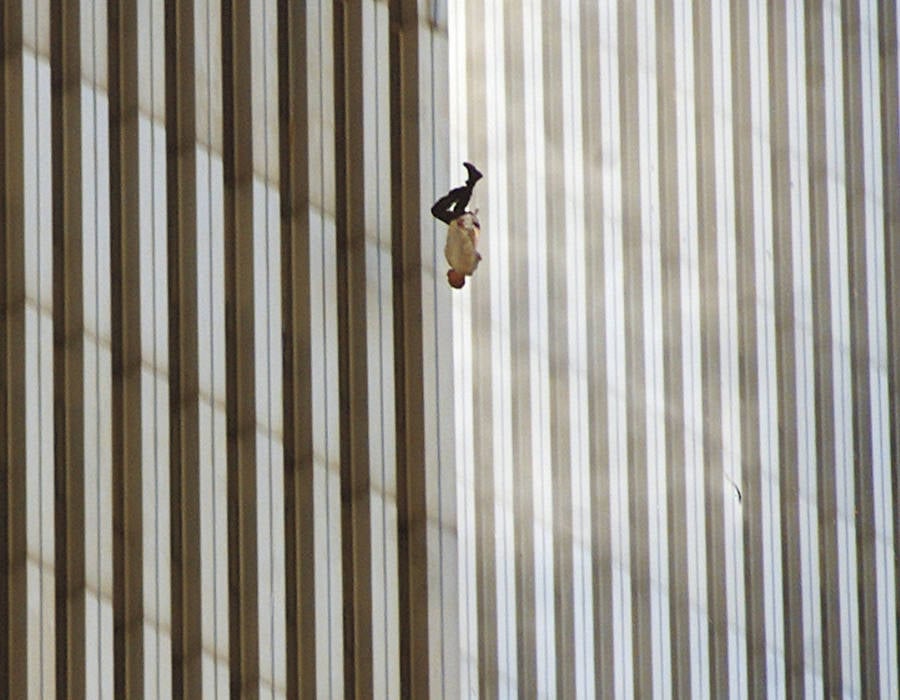
Never Forget


This photograph to me perfectly captures the savagery of that day. I was working for a startup that was about to miss its first payroll. My wife called to tell me our son, who was 14, I think, came and told her that something big was happening: the first plane crashing.

I have no idea what I did for the rest of the day. I suspect I just kept hacking away at porting DHCP server to our idiosyncratic operating system. Things I do remember clearly:

1. The following Sunday was the most heavily attended church service that I could recall.

2. President Bush giving one of the strongest speeches of his career. Bush had always tried to come across as an "Aw, shucks" Texas country bumpkin. When he needed to do Leader of the Free World, he could and did. Even a friend from Texas who hated him for that country bumpkin act agreed that he did a fine job addressing the nation.

3. That Saturday, our local paper, the Santa Rosa Press-Democrat, solved the sudden shortage of American flags by printing a full color back page.

4. There was a unanimity of purpose for a month or two that was doubtless what Americans felt after Pearl Harbor.

5. Canadians in Gander took in thousands of Americans whose flights were interrupted by the ground stop. We will always be grateful for that. We really want to be on good terms with Canada again. 

Unfortunately, what people born after 9/11 know, if anything at all about it is likely:

1. We had it coming.

2. Bush did it.

3. The Jews did it.

4. It does not matter because this is "stolen land."

Thursday, September 10, 2026

How Did I Miss This Craziness?

 3/21/1977 Time:

The heart of the capital was under siege. Everywhere, it seemed, was the wail of sirens, snarled traffic, milling crowds, police marksmen poised on rooftops, swarms of reporters interviewing one another in the glare of floodlights. Extra guards were posted at Government buildings; on the Hill each member of Congress was offered an armed police escort. The Washington Monument was temporarily closed to visitors: it was within the range of snipers. Affairs of state moved forward—cautiously. At the end of his visit with President Carter, Israeli Prime Minister Yitzhak Rabin left quietly with no farewell ceremony; incoming British Prime Minister James Callaghan did not receive the traditional 19-gun salute, for fear it might trigger a slaughter. All this was the work of a mere dozen men who held 132 hostages in three Washington buildings for a chilling 38 hours. The terrorists made dramatically clear what has become all too obvious: anybody with a cause and a gun, be he mad or madcap, fanatic or eccentric, can seize and hold national attention by kidnaping and threatening to kill innocent victims.

The Washington assault was the culminating event of a spate of terrorist acts that have bedeviled the country. It proved again how vulnerable the society is to such attacks. Given the circumstances, it was wondrous that the drama ended with so little blood spilled: one dead and four wounded by gunfire, a dozen others cut and beaten. That the toll was not higher was in part a tribute to the primary tactic U.S. law enforcement officials are now using to thwart terrorists—patience (see box). But most of all, perhaps, it was due to the courageous intervention of three Muslim ambassadors, Egypt’s Ashraf Ghorbal. Pakistan’s Sahabzada Yaqub-Khan and Iran’s Ardeshir Zahedi.

The Washington siege was an explosive mixture of gangsterism, revenge, racial hostility and religious bickering elevated, as the participants proclaimed, to the level of a holy war. The terrorists were members of a sliver-sized religious organization called the Hanafi—a rival of the much larger Black Muslims, a group that has been plagued with violence over the years but has recently become more subdued (TIME, March 14).