Monday, February 28, 2011
How Busy Am I?
I'm training someone from church in how to machine ScopeRoller parts. I don't have time to manufacture, teach, and work full-time for the State of Idaho. Now, if only the ScopeRoller orders would roll in so fast that I had to make this guy full-time...


Sunday, February 27, 2011
Friday, February 25, 2011
Ubuntu Linux 10.04 LTS
Each release gets a bit better. I have an antique HP Pavilion 7920 under my desk that I have kept around mostly because there is no one that would want it. It is a 900 MHz Pentium with 256 MB of RAM, and a total of about 35 GB of disk space, in two separate physical drives. (Try not to laugh too loudly.)
I sometimes upgrade the version of Ubuntu Linux on it to see if Linux has reached the point where I can recommend it to people that aren't techies as an alternative to Windows. Each time, I find myself saying, "Not quite, but it is getting real close." It seems as though Ubuntu Linux is asymptotically approaching Windows in terms of usability--which means that it will reach parity near the end of the century (or perhaps the millennium). Anyway: real progress.
It does seem as though its performance demands of Linux are getting more severe with time, however. I can run Firefox or Chromium (the Linux version of Chrome) on it. I can run one other relatively small application. Try to open a third application, and it bogs down hopelessly. Try to run one seriously demanding application, such as the Eclipse Galileo Java IDE, and you will die of old age before you get around to writing any Java--much less compiling and executing it.
I've thought of upgrading the RAM on this box--but oddly enough, the :Linux System Monitor application show that it is more CPU bound than RAM bound. Upgrading it to 512 MB of RAM would enable it to perhaps even run Eclipse, but it would not be particularly quick. It might make more sense to reinstall Windows 98 (I have the restore disks, amazingly enough) and find some charity that needs a basic computer for word processing.
I have another notebook lying around which is a Compaq NC6000 and screaming fast (considering its age). I use this when I need to take a notebook along, and I want something smaller and lighter than the notebook that I use at home. I have thought of installing Ubuntu Linux on it as a dual boot system with Windows XP Pro, but it only has a 20 GB hard drive, and about half of it is in use. I have thought of buying a replacement 2.5" notebook drive for it, perhaps 60 GB or 80 GB, but this is mostly to keep my experience with Linux up, so it is hard to justify spending anything on it. Does anyone have an EIDE 2.5" notebook hard drive >60 GB lying around that they don't need?
I sometimes upgrade the version of Ubuntu Linux on it to see if Linux has reached the point where I can recommend it to people that aren't techies as an alternative to Windows. Each time, I find myself saying, "Not quite, but it is getting real close." It seems as though Ubuntu Linux is asymptotically approaching Windows in terms of usability--which means that it will reach parity near the end of the century (or perhaps the millennium). Anyway: real progress.
It does seem as though its performance demands of Linux are getting more severe with time, however. I can run Firefox or Chromium (the Linux version of Chrome) on it. I can run one other relatively small application. Try to open a third application, and it bogs down hopelessly. Try to run one seriously demanding application, such as the Eclipse Galileo Java IDE, and you will die of old age before you get around to writing any Java--much less compiling and executing it.
I've thought of upgrading the RAM on this box--but oddly enough, the :Linux System Monitor application show that it is more CPU bound than RAM bound. Upgrading it to 512 MB of RAM would enable it to perhaps even run Eclipse, but it would not be particularly quick. It might make more sense to reinstall Windows 98 (I have the restore disks, amazingly enough) and find some charity that needs a basic computer for word processing.
I have another notebook lying around which is a Compaq NC6000 and screaming fast (considering its age). I use this when I need to take a notebook along, and I want something smaller and lighter than the notebook that I use at home. I have thought of installing Ubuntu Linux on it as a dual boot system with Windows XP Pro, but it only has a 20 GB hard drive, and about half of it is in use. I have thought of buying a replacement 2.5" notebook drive for it, perhaps 60 GB or 80 GB, but this is mostly to keep my experience with Linux up, so it is hard to justify spending anything on it. Does anyone have an EIDE 2.5" notebook hard drive >60 GB lying around that they don't need?
Thursday, February 24, 2011
Manufacturing Consent
That was a title of a book by Noam Chomsky some years ago--but this seems to be it, actually. From Fox News:
The US government is offering private intelligence companies contracts to create software to manage "fake people" on social media sites and create the illusion of consensus on controversial issues.It's bad enough when the government lies about things--but manufacturing the appearance of a grassroots support with fake personae? This is right up there with making humanoid robots to go vote!
Alcohol & Guns Do Not Mix
Alcohol and practically anything dangerous don't mix. From the February 24, 2011 Idaho Statesman:
A Horseshoe Bend man playing with a handgun after a night of drinking accidentally killed himself, according to a release from the Boise County Sheriff's Office.No, I don't know him. I don't have friends who drink to the point of fatal stupidity.
Wednesday, February 23, 2011
Interesting Picture From a Forgotten Atrocity
The term "concentration camp" wasn't invented by the Nazis. It was used to describe the camps that the British government used to "concentrate" Boer civilians during the Boer War, and that the Spanish government used to concentrate Cuban civilians during the war with the rebels in the 1890s. In both cases, conditions were harsh--and in the case of the Boer War, apparently intentionally so, to destroy the will of the Boer men to keep fighting, knowing that their wives and children were locked up in disease-ridden settlements with insufficient food.
I do not know from my reading whether the Spanish concentration camps were intentionally death camps, but a student in my U.S. History class brought in an album of pictures from an ancestor who was apparently a general during the Spanish-American War and World War I. This picture in particular was quite disturbing. That's not cotton.
 click to enlarge
I do not know from my reading whether the Spanish concentration camps were intentionally death camps, but a student in my U.S. History class brought in an album of pictures from an ancestor who was apparently a general during the Spanish-American War and World War I. This picture in particular was quite disturbing. That's not cotton.
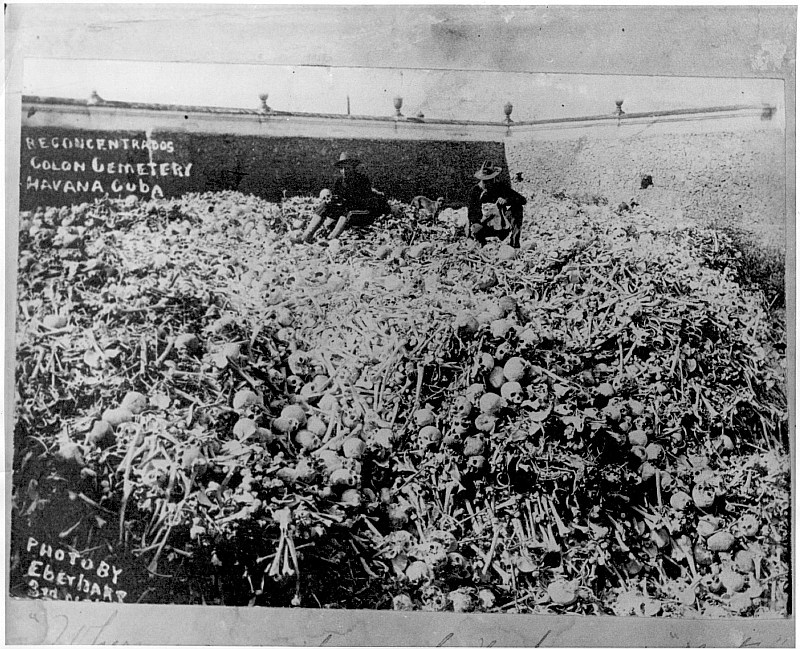 click to enlarge
Monday, February 21, 2011
Happiness Runs (2010)
I caught this on Netflix--and it is a sobering film. It opens with what looks like 8mm home movies of a rural hippie commune in the 1960s with a very powerful soundtrack, and interviews that bring back so many memories of the good intentioned delusions of that time. Then the film flashes forward 20 years later. The adults are no longer young. Rutger Hauer (as usual) is pitch perfect as the spiritual leader of the commune, using his charisma as a way to have every woman in the place--and waiting (just barely) until the girls are old enough. This is only alluded to--not shown (thank goodness).
The other adults are either showing the signs of too many years of mind-altering drugs, New Age delusion, or the wear of too many years. While I have never been impressed with Andie McDowell as an actress (even when doing hair product commercials), she really does a fine job here as a woman who knows that something has gone terribly wrong, but is unwilling to face up to it, and leave the only structure that she has known for all this time.
But it is not the adults that are the tragedy--it is the kids, raised in a culture where the ten year olds are smoking pot (after all, everyone does), the teenagers are as promiscuous as the adults, and have lives as pointless and empty as you might expect. It reminded me of a more somewhat extreme version of living in Sonoma County (except that everyone had separate houses, instead of living on a commune).
This is a harsh, uncompromising film. It is dark. It is depressing. The filmmaker modeled the story on his own growing up in a rural Vermont commune. The May 7, 2010 New York Times review says some nice things about it, but of course, there has to be one backhanded insult:
The comments on the New York Times article include some indignant responses from others who grew up on the same commune as filmmaker Adam Sherman, and who think his portrayal is unfair and false. That is the nice thing about calling a film "autobiographical": you don't have to make it literally true to still be a powerful commentary on what happens when you abandon the traditional structures.
By the way, I am not sure that I would call this a great film. Maybe not even a particularly good film. It is a film whose subject matter is so powerful that it transcends the filmmaker's craft.
The other adults are either showing the signs of too many years of mind-altering drugs, New Age delusion, or the wear of too many years. While I have never been impressed with Andie McDowell as an actress (even when doing hair product commercials), she really does a fine job here as a woman who knows that something has gone terribly wrong, but is unwilling to face up to it, and leave the only structure that she has known for all this time.
But it is not the adults that are the tragedy--it is the kids, raised in a culture where the ten year olds are smoking pot (after all, everyone does), the teenagers are as promiscuous as the adults, and have lives as pointless and empty as you might expect. It reminded me of a more somewhat extreme version of living in Sonoma County (except that everyone had separate houses, instead of living on a commune).
This is a harsh, uncompromising film. It is dark. It is depressing. The filmmaker modeled the story on his own growing up in a rural Vermont commune. The May 7, 2010 New York Times review says some nice things about it, but of course, there has to be one backhanded insult:
This strident exposé may gladden the hearts of some anti-’60s conservatives, but it is a shapeless mess steeped in prurience. Its grain of truthfulness, however, is just enough to leave you unsettled in the pit of your stomach.I'm not quite sure "prurience" is quite the right word here. Yes, we see more of Hannah Hall naked than was really quite necessary. On the other hand, there is a reason that some of the sex is in this film--to remind us that the mindless worship of sex as an end in itself is ultimately not very satisfying--it just leads to more and more combinations of parts, rather than confront that the deepest meaning in life is not sex, or any other fleshly pleasure.
The comments on the New York Times article include some indignant responses from others who grew up on the same commune as filmmaker Adam Sherman, and who think his portrayal is unfair and false. That is the nice thing about calling a film "autobiographical": you don't have to make it literally true to still be a powerful commentary on what happens when you abandon the traditional structures.
By the way, I am not sure that I would call this a great film. Maybe not even a particularly good film. It is a film whose subject matter is so powerful that it transcends the filmmaker's craft.
Subscribe to:
Posts (Atom)